Cesar was 25 years old and out of work when he walked into a Miami CarMax in August 2020 and filled out an application for a $49,000 Mercedes.
He had no steady job and no real income, but that didn’t matter because the car was never meant for him.
Within a day, he handed the keys to a man he had met only weeks earlier, Alejandro Soto, (aka Alex) who ran a luxury rental business that put cars on Turo.
Over the next two weeks Cesar bought and financed a lot of cars. They included a Mercedes, a Maserati, two Camaros and a Land Rover, each using the same false paperwork, and each handed straight to Soto after leaving the dealership.
After 30 days, he brought in his sister, his father and a friend to do the same for Alex.
Cesar was one of the first in a long chain of straw borrowers that helped arm Alex Soto with a fleet of cars for his rental business called Venom Luxury Rentals.
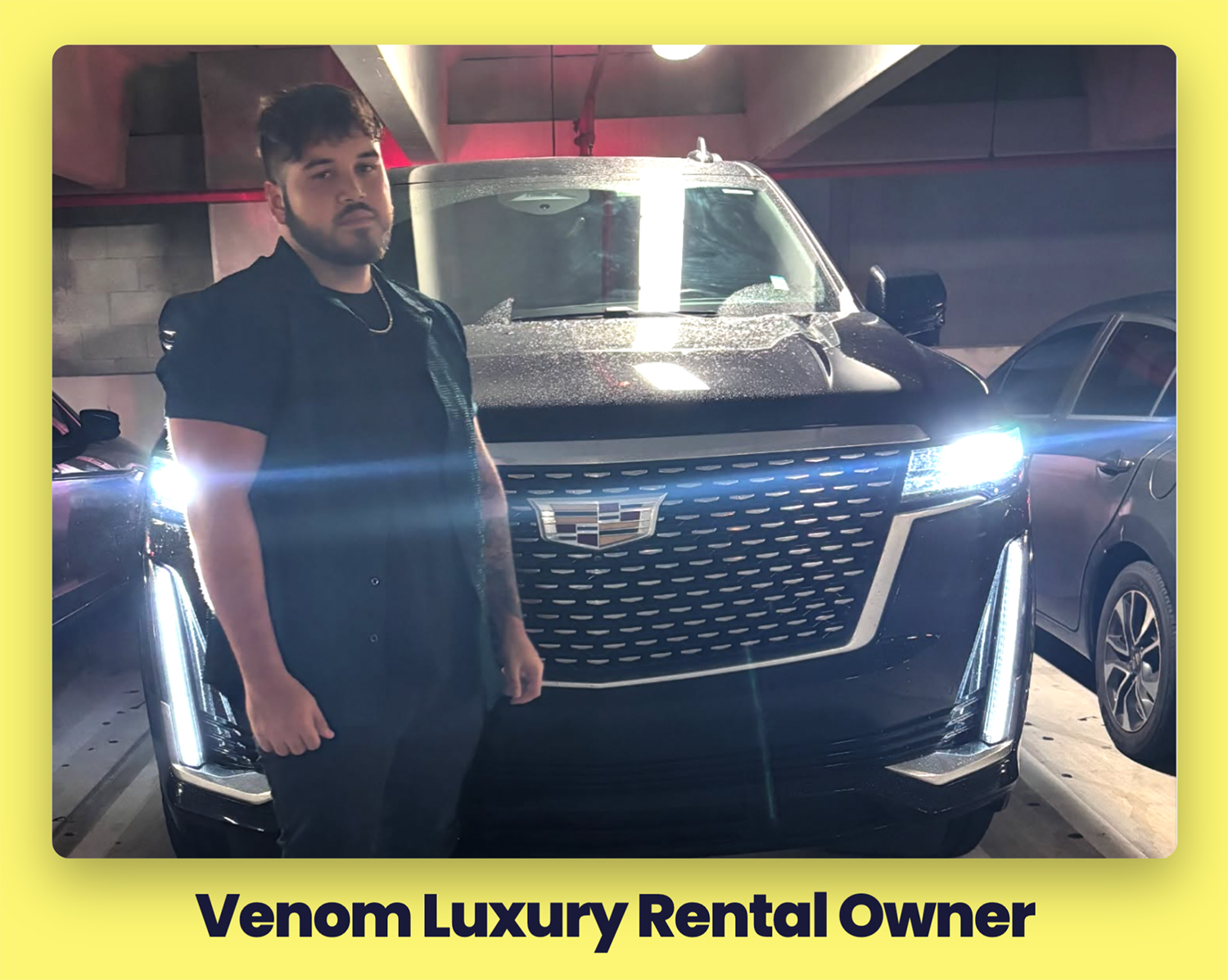
100 Cars Generating $600,000 In Revenue On Turo
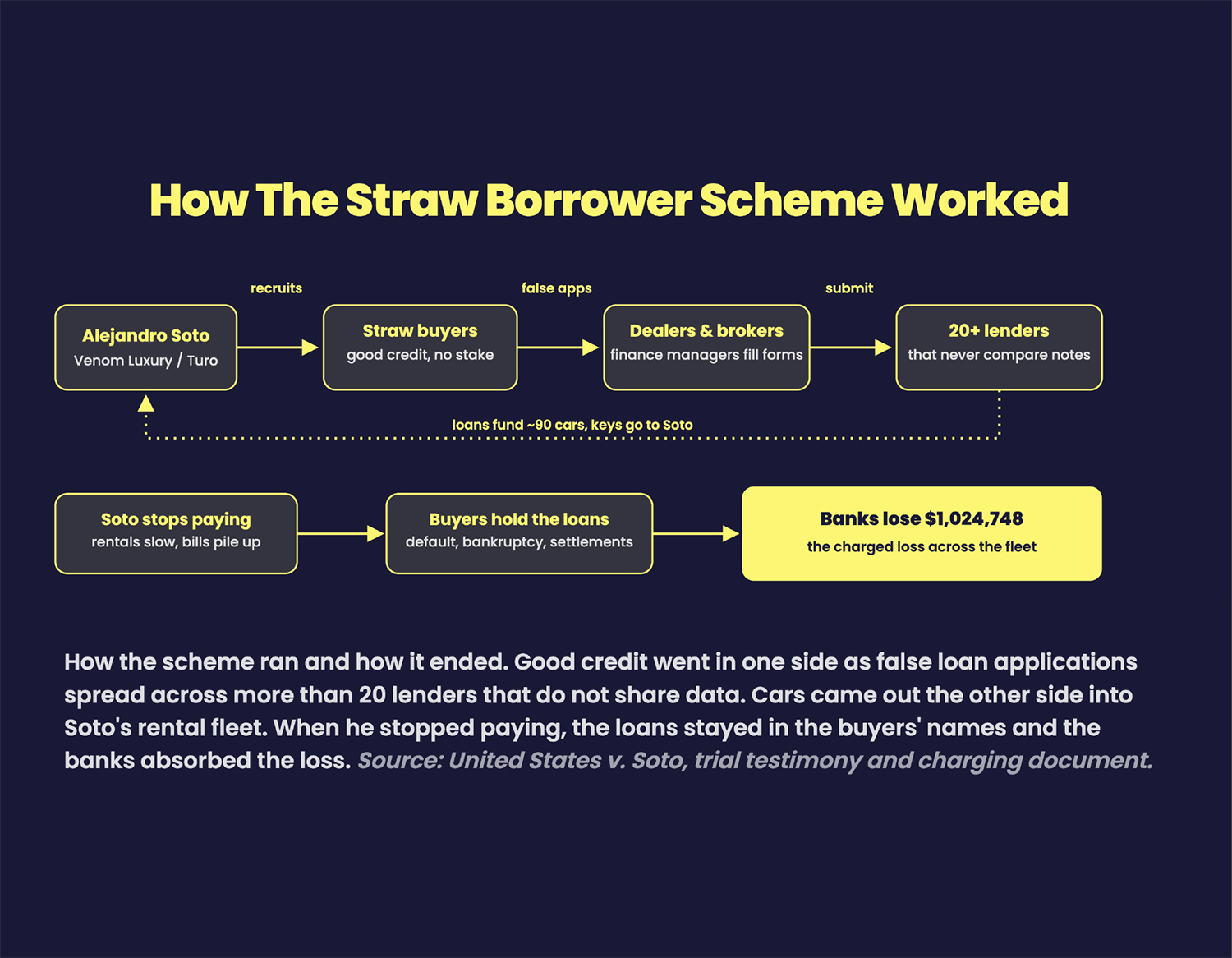
By early 2021 Soto had close to a hundred cars sitting on a lot in Miami, and almost none of them were financed in his own name. He had to recruit 16 straw borrowes to get the cars.
The borrowers were told that a car generated between $5,000-$8,000 a month from rentals and were promised a 50/50 split of any profits made. Soto also claimed he would be responsible for making all the loan and insurance payments, plus handling all the associated maintenance expenses.
The story of how it happened was revealed in court documents which I downloaded. It provides enormous details on how the straw borrower fraud ring worked.
In late February 2026, Soto stood trial in federal court in Miami, and two of his own co-conspirators took the stand for the government and walked a jury through it step by step.
One was Cesar Cespedes, the first straw buyer. The other was Javier Calunga, the dealer who sold many of the cars and admitted his own shop faked details on the loans.
What follows is their account of how a crew turned good credit into cash, beat the checks that were supposed to stop them, and left a stack of banks and their own families holding the bad loans.
What Soto Was Selling And Why He Needed Strangers To Help
Alex Soto was the chief executive of Venom Luxury Rentals Corp, a company he used to list cars for rent on Turo, the app that lets people rent vehicles from each other.
The business itself was legal. Renting cars on Turo is not a crime. But the problem was how Soto got the cars.
Buying and financing a fleet of Turo cars takes great credit and commercial loans, and Soto did not have either. Calunga, a car dealer in the case, told the jury that Soto and his girlfriend “had bad credit,” and that “with the bad credit, you cannot get so many cars. Perhaps not even one.”
So Soto went looking for people who did have good credit. The pitch was simple, and Cesar Cespedes repeated it almost word for word from the witness stand.
“We were going to buy the car and we were going to give it to the Defendant.”, Cepedes said, “He was going to rent it out. And after paying the loan to the bank, pay whatever expenses were required for the car, the profits then would be divided half and half between him and myself.”
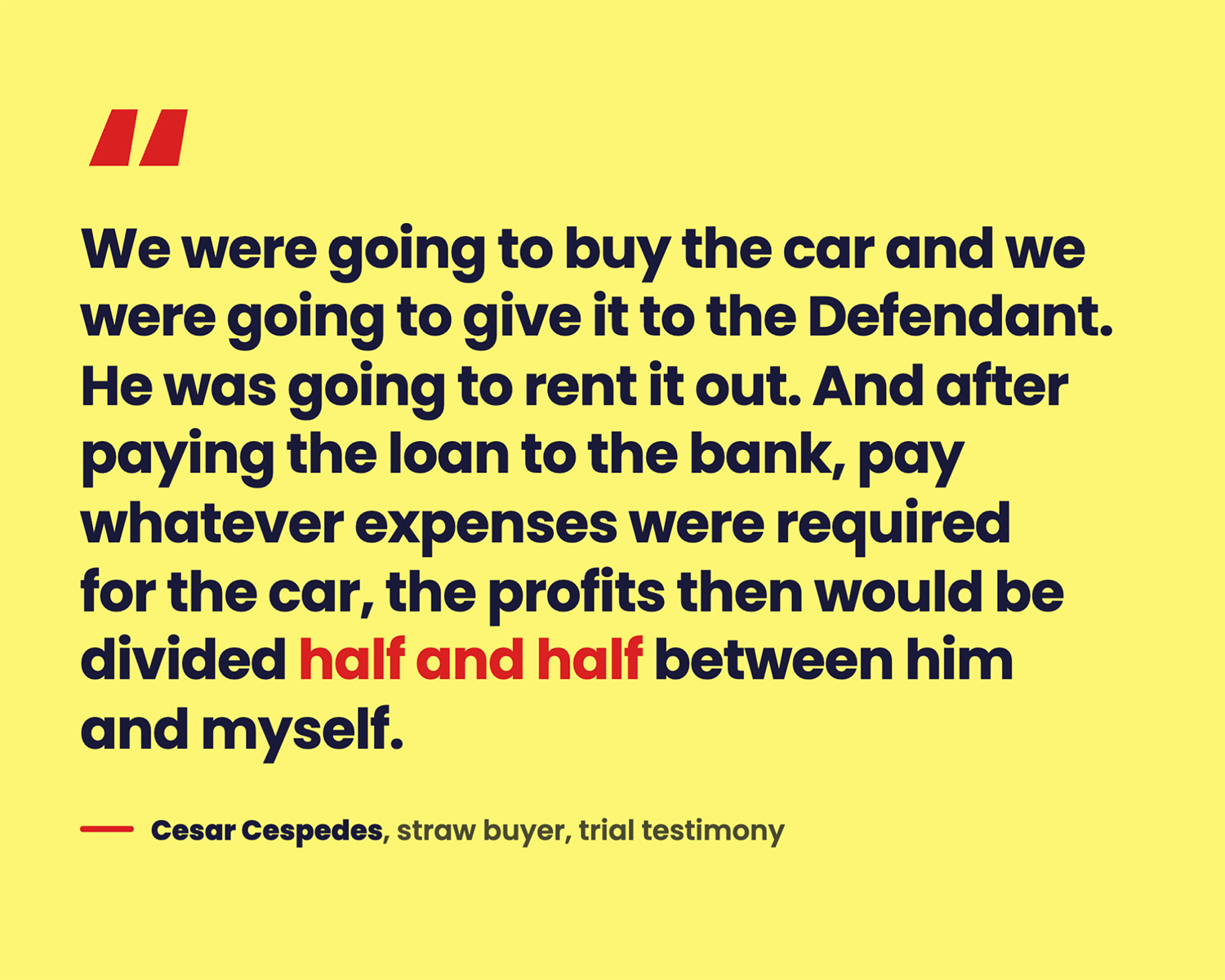
The good credit was the key to make it all work. Cespedes said the arrangement he understood from the start was “the deal to get people who had good credit in order to be able to buy the cars.”
And more cars meant more money. Soto never gave him a target number, Cespedes said, but “he told me that the more cars to be purchased the better.”
To reassure his recruits, Soto told Cespedes he had money in the stock market “in order to back up the deal” if anything went wrong. When the loans later went bad, that money never appeared.
The Car Dealer That Confessed
To make the straw borrower scheme worked, Soto needed a dealer to help him.
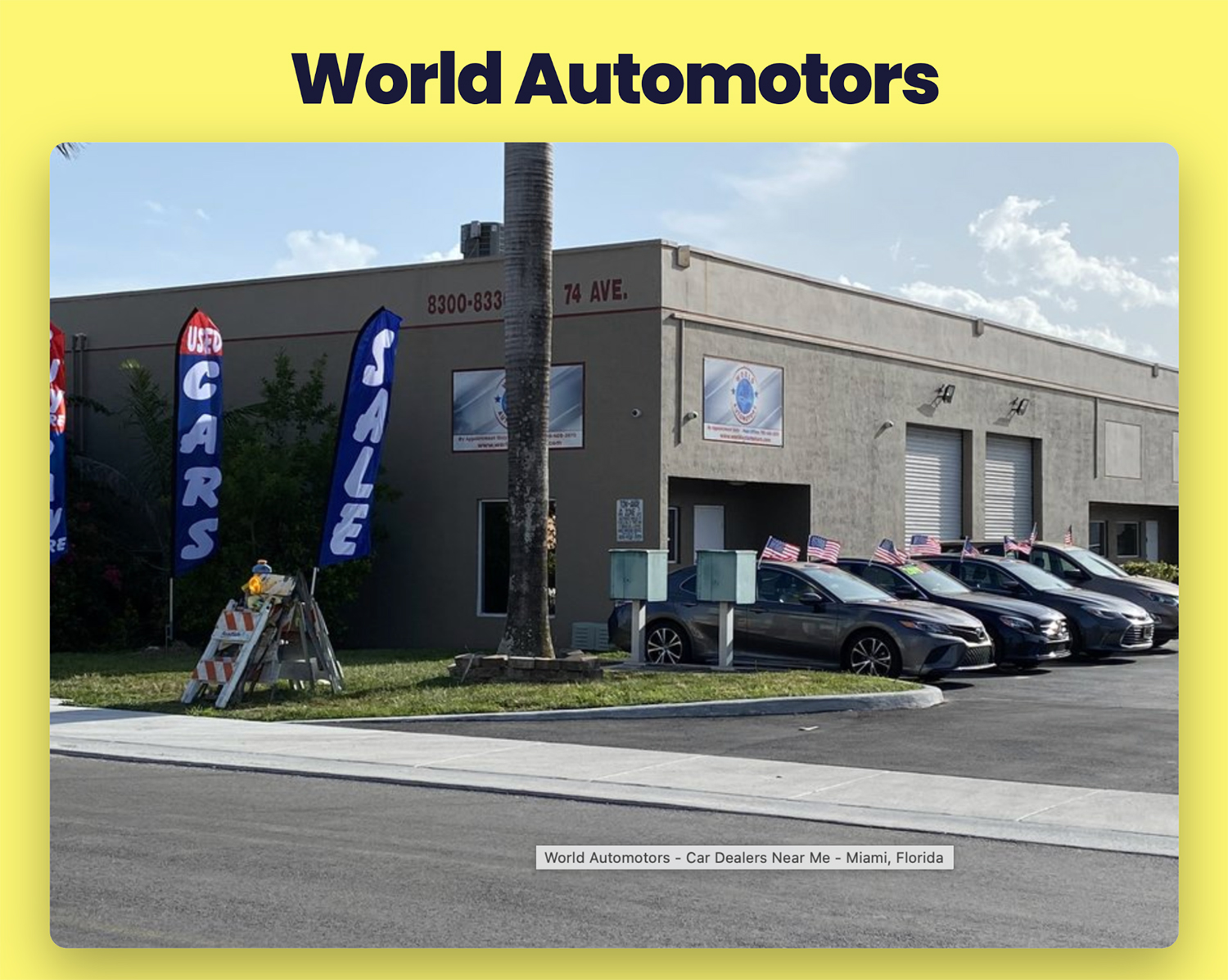
The most damaging witness against the paperwork was the man who sold the cars. Javier Calunga owned World Automotors, a small used-car dealership in Medley, near Hialeah, run out of a warehouse with room for six to eight cars.
Calunga had spent years in car finance before this, at Toyota dealerships around Miami. He knew exactly what a clean deal looked like, and he admitted his shop was not running clean ones.
That’s what made the whole scam work.
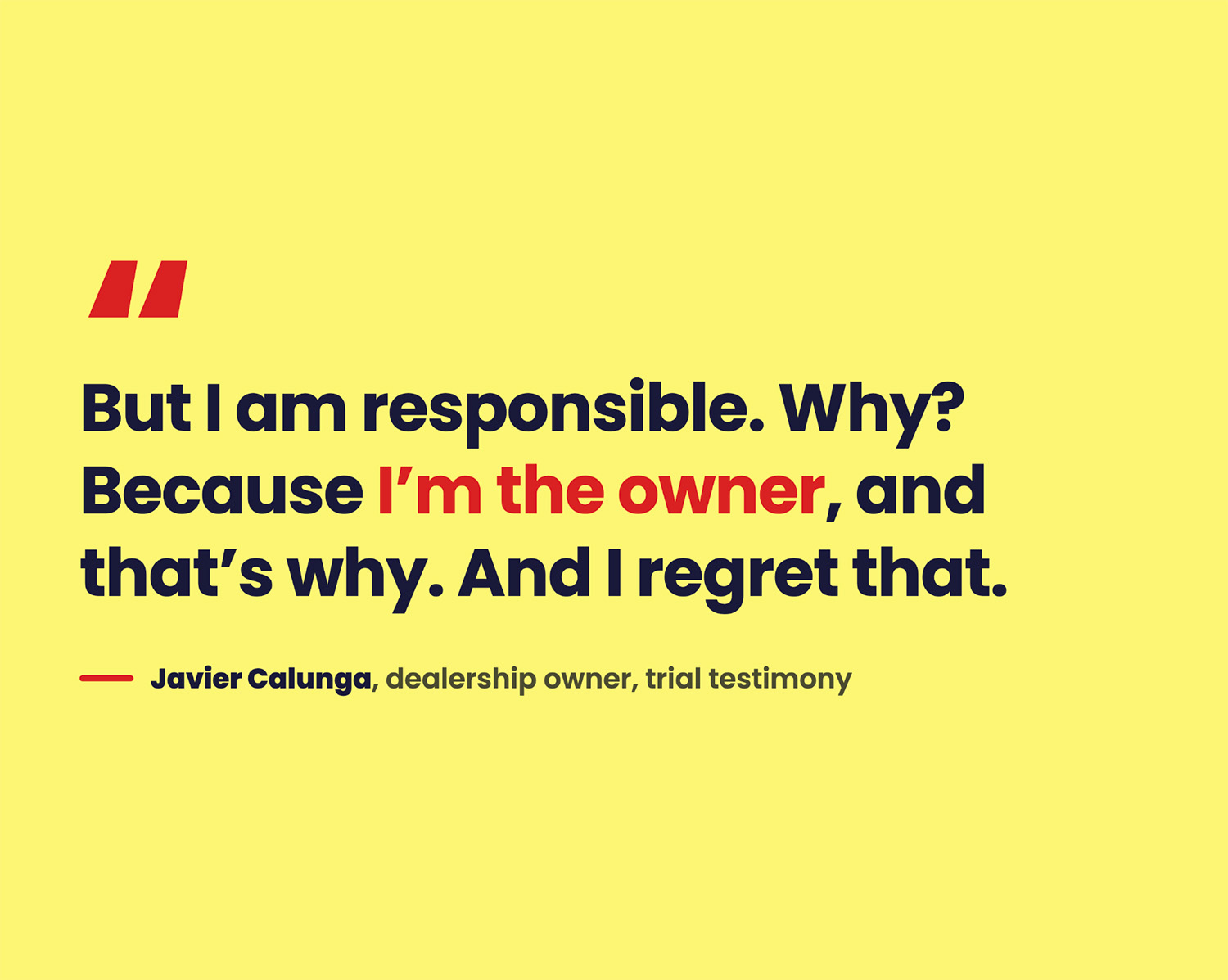
He pleaded guilty to conspiracy to commit wire fraud and told the jury why. “Because I was guilty. I had made a mistake, and I admitted my mistake, so I was guilty.”
At his dealership, the fake paperwork and false documents came from one man, his finance manager, Gustavo Navarrete, who split half the profit on every car. Navarrete entered the income, chose which banks to hit, listed the fake down payments and produced the fake employment documents.
Calunga said he did not catch it at first, and by the time he did, “It was too late already.” He told Navarrete to stop, and it did not stop.
In the end, he took responsibility anyway. He said he was the owner and that is why.
Soto Never Cared About The Price, Just The Monthly Payment
Once a car was financed, the straw buyer drove it straight to a lot and handed over the keys. Cespedes said it the same way about car after car: “I gave them to the Defendant (Alex).”
His girlfriend helped run the operation, handling check-ins, check-outs, photos, bank payments and what Cespedes called the accounting.
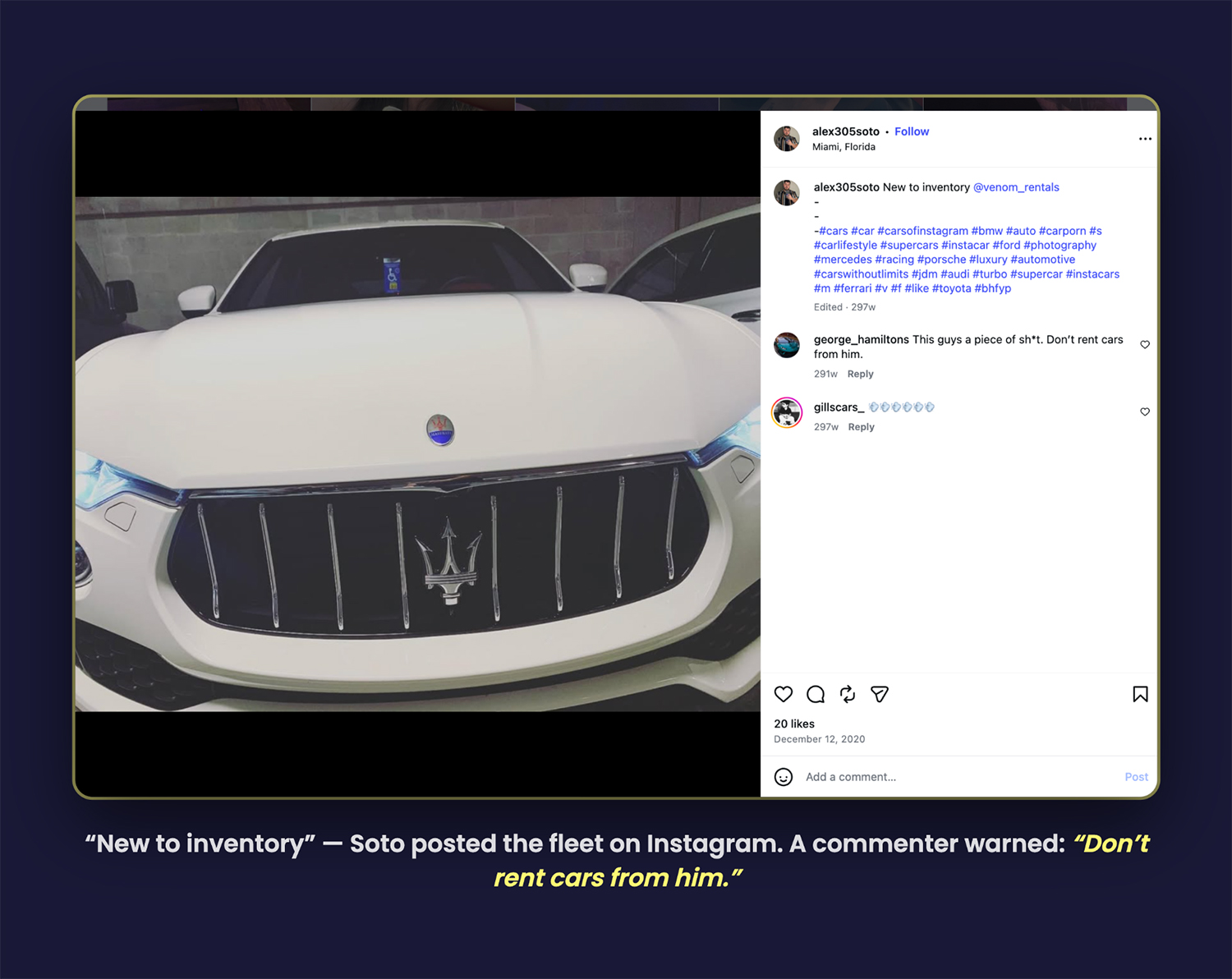
The cars went onto Turo. Cespedes photographed each one and sent the images to Soto to post for rent.
Some cars, he said, Soto also rented out off the platform, on his own.
Calunga heard the business model from Soto directly, and said Soto “would like to brag about it.” What Soto cared about was never the sticker price of the car.
“He was not interested in how much they were going to pay for the cars”, testified Javier Calunga.
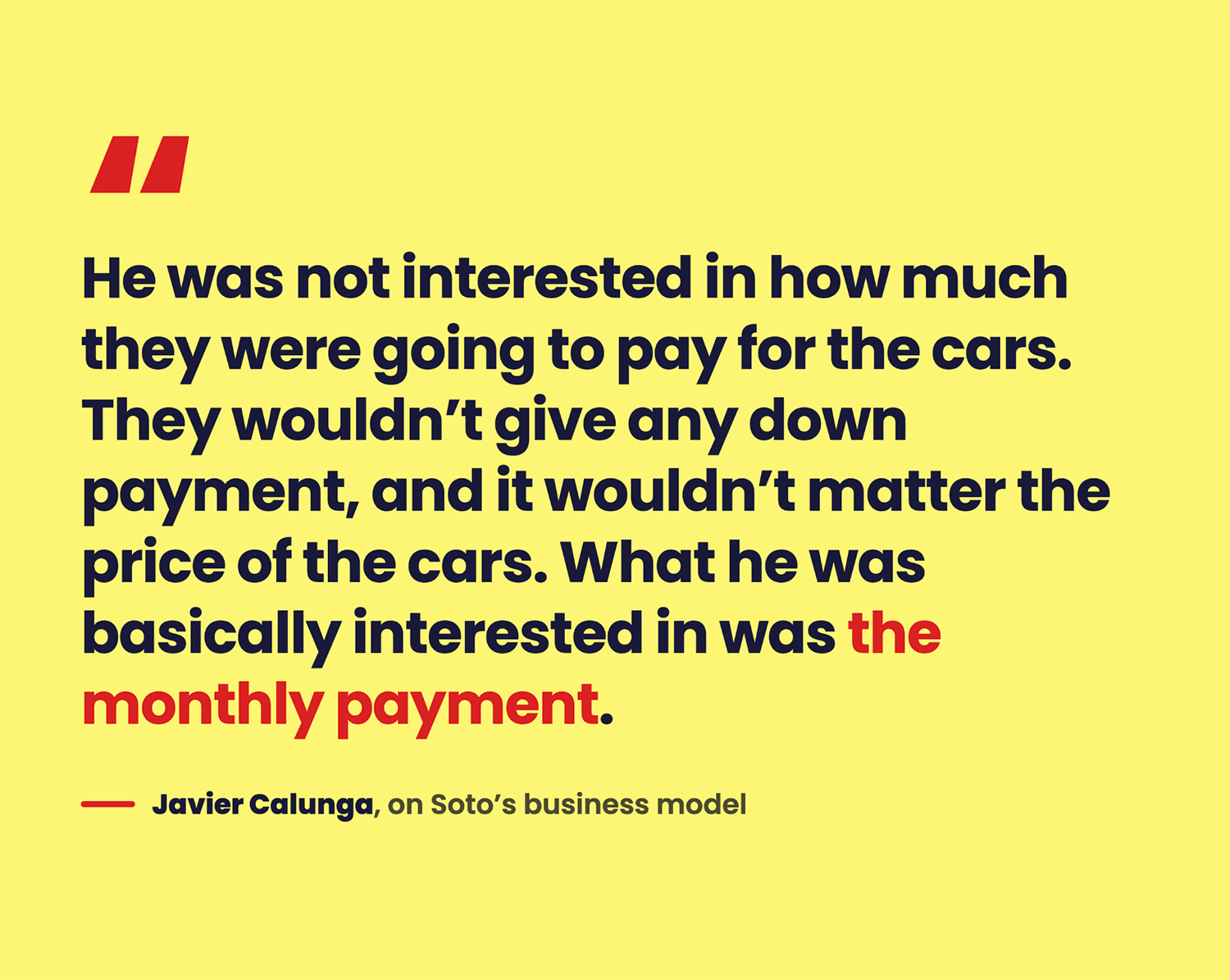
They wouldn’t give any down payment, and it wouldn’t matter the price of the cars. What he was basically interested in was the monthly payment.
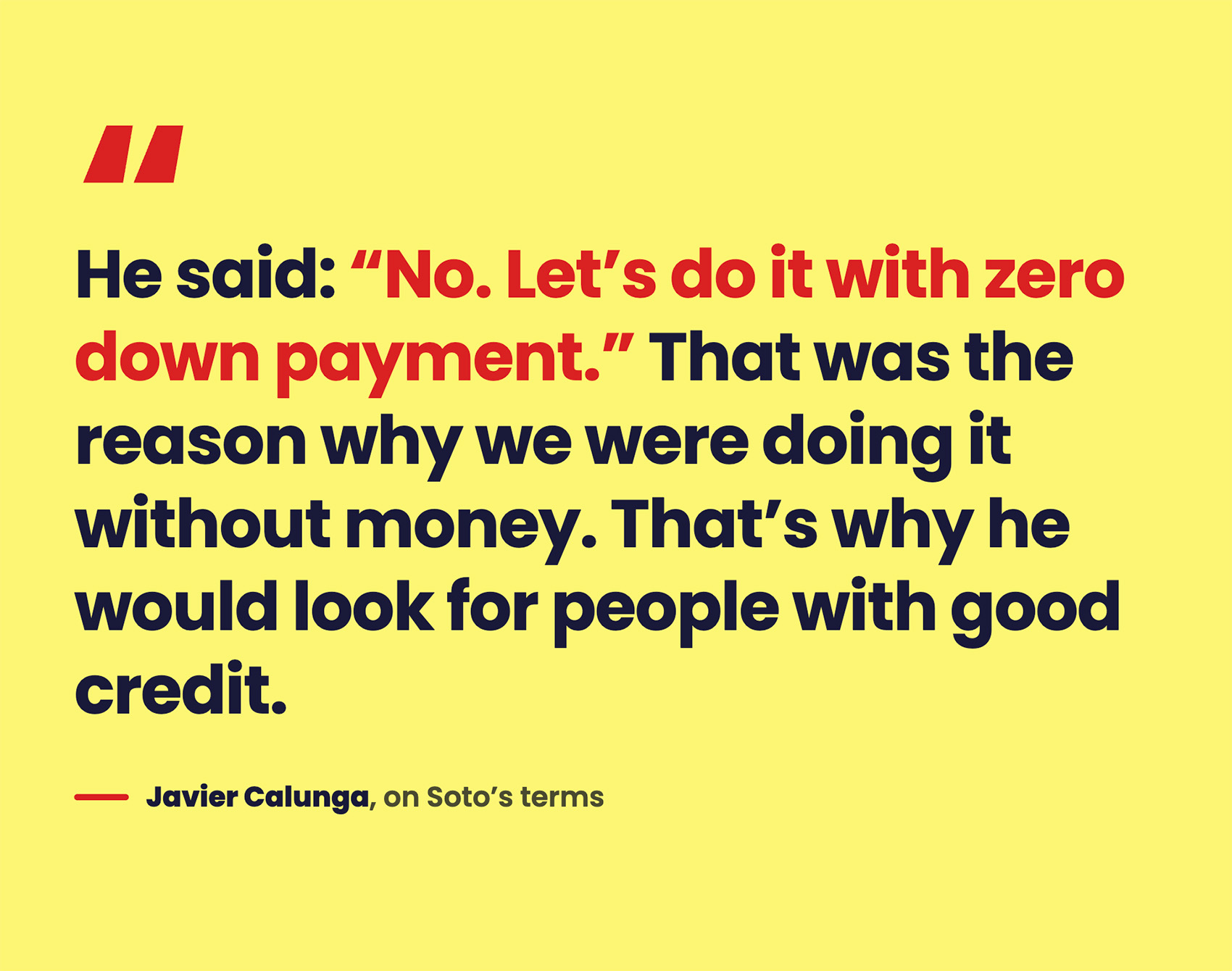
Soto picked the cars himself and told the dealer which ones he wanted, Calunga said, walking in and saying: “These are the cars. I want these cars. I’m not going to pay any down payment for these cars. And these are the clients or the customers for those cars.”
He wanted the bigger dealerships and the flashier inventory, the Corvettes and Maseratis, because a rental fleet needed cars people wanted to rent.
Asked how many cars Soto planned to pull together this way, Calunga did not hesitate: “More than one hundred cars.”
How The Beat The Banks – The 30 Day Blind Spot
A car loan does not show up on your credit report the moment you sign. There is a lag, and the crew built the entire timing of the scheme around it.
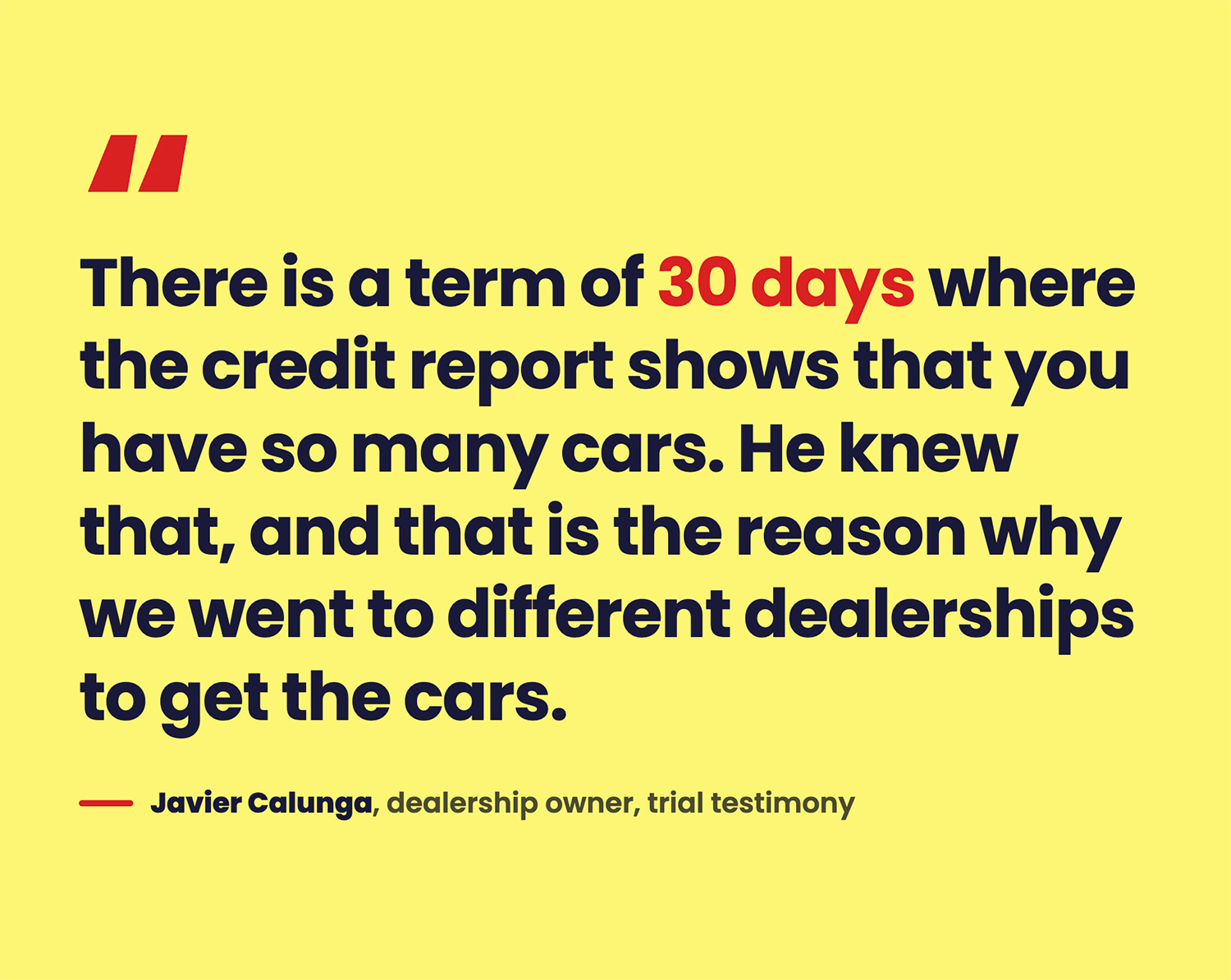
Cespedes said the instruction from Lazaro was exact: the cars “had to be purchased in a period less than a month, so that way the purchase of the car would not appear in the credit report.” Buy them all inside that window, and each new lender still sees a clean borrower with no recent car debt.
Calunga described the same rule from the dealer’s side, and said Soto knew it as well as anyone.
Banks Don’t Communicate With Each Other
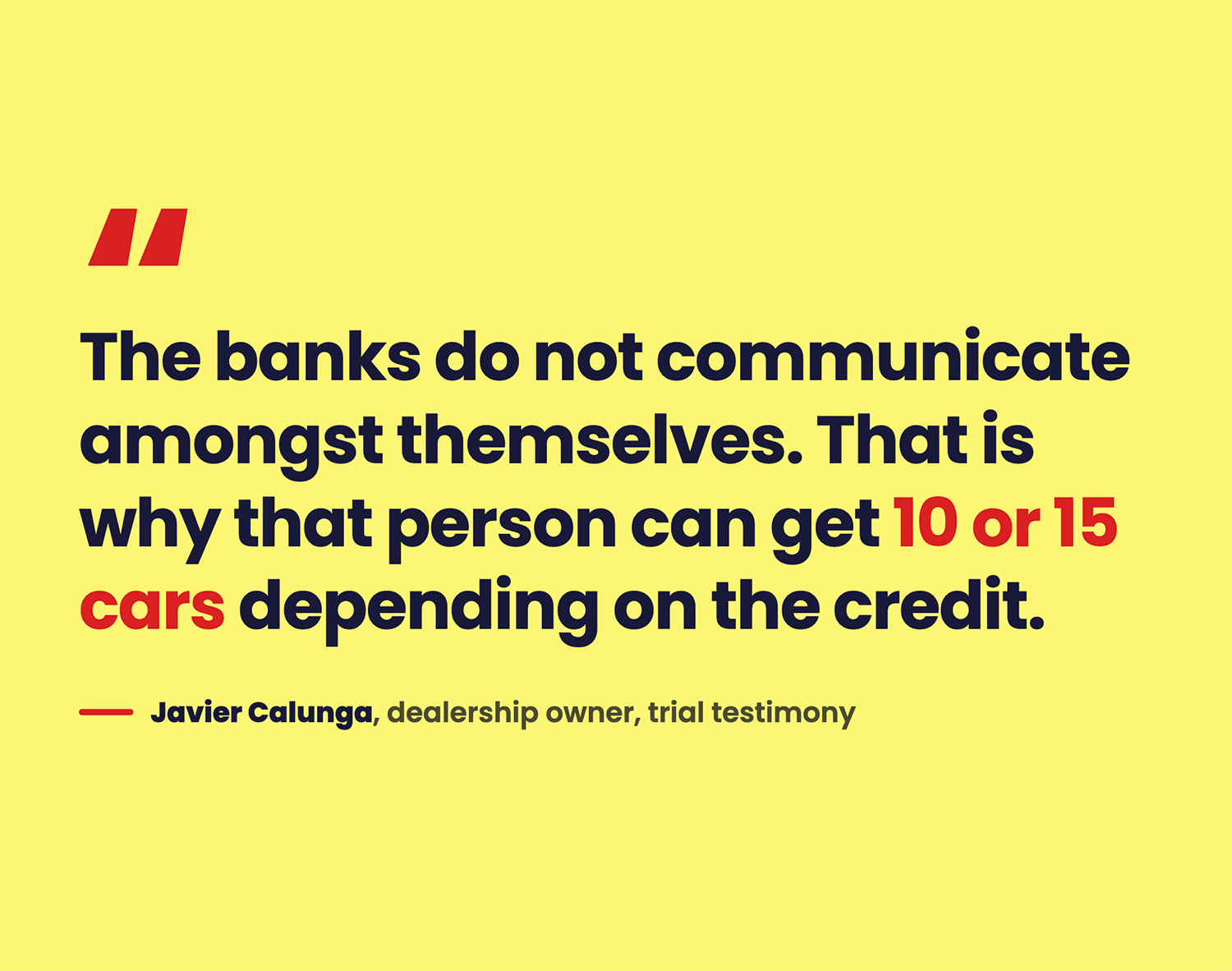
The second blind spot is that banks do not talk to each other in real time. One lender approving a loan has no idea another lender approved one an hour earlier.
Cespedes said Soto explained exactly why they spread the deals around: “We wouldn’t send the inquiry to that same bank, so that way the banks wouldn’t find out that we were purchasing different cars.”
Calunga put the same point in dealer terms. “The banks do not communicate amongst themselves. That is why that person can get 10 or 15 cars depending on the credit.”
Fake Jobs And Fake Income and Fake VOE
Cesar Cespedes’s applications listed him as a manager earning $8,800 a month at a company called MadStarz. He was unemployed and collecting jobless benefits at the time.
Asked how he planned to get approved with no job, he did not make an excuse: “We were going to lie in the loan application.”, he said.
When the crew needed a second fake employer, they used one called Total Cabling, and Cespedes’s name went on a Total Cabling pay stub. He testified he never worked there. “Never.”
The interesting part was the verification call. Banks usually phone the employer to confirm a borrower really works there and earns what the application claims.
The crew had that covered too.
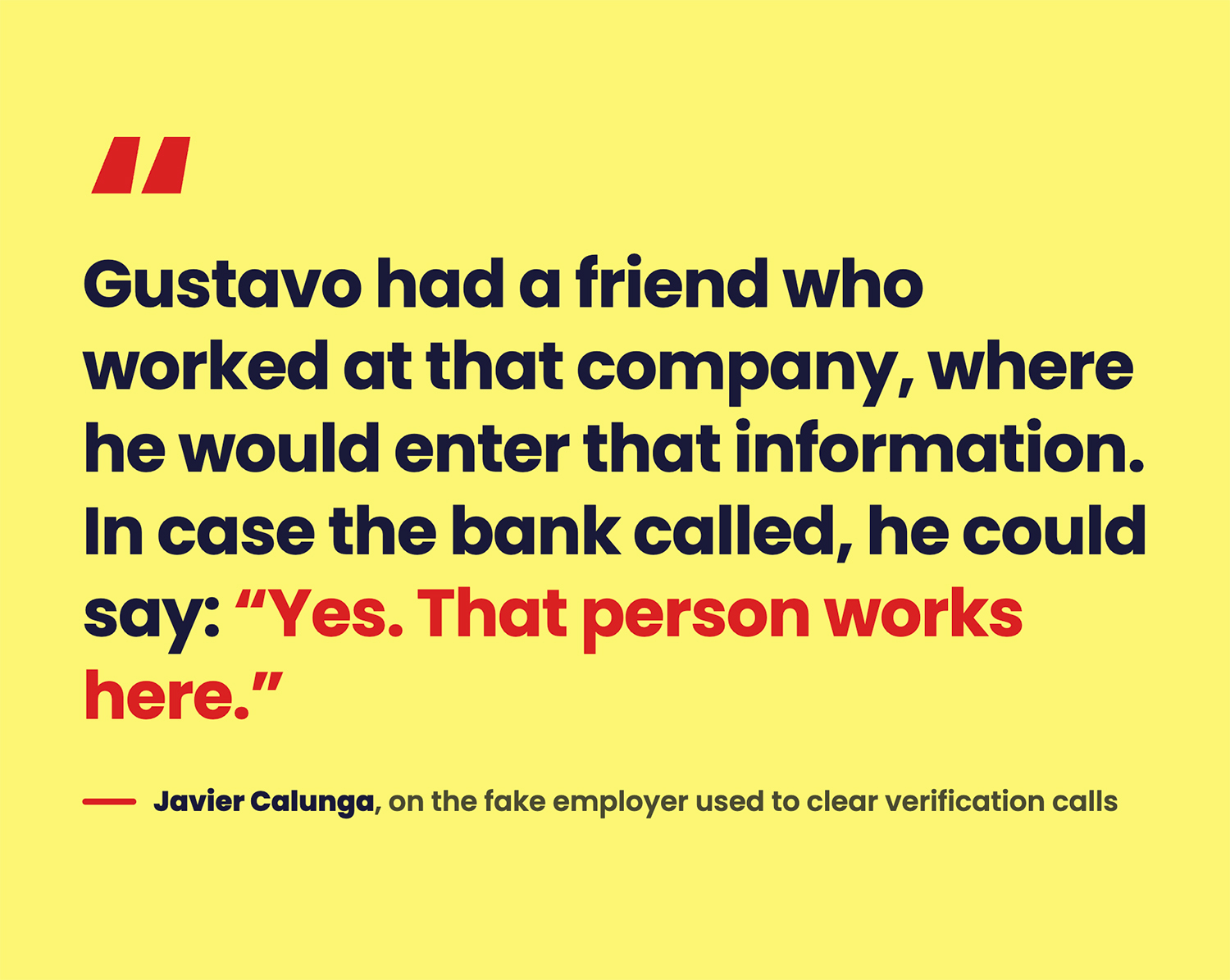
Calunga said the banks “almost always call” to confirm employment, so the inside contact at the fake employer was what let deal after deal go through.
Another straw buyer, a school security guard, was papered up with a fake employer called Karlito’s Tapiceria, complete with a pay stub and a W-2, because the finance manager knew someone there too.
Ghost Down Payments Made The Loan Look Even Better
Auto lenders will only finance so much of a car’s value. When the loan runs over that limit, a down payment is usually required.
The contracts showed down payments. But that was falsified, because no money ever changed hands. The dealership used a practice of “Ghost Down Payments” to make the loans look better.
Calunga walked the jury through one contract that listed a $4,500 down payment “which was never given,” put there, he said, “for the approval.”
On paper the loan-to-value math worked. In reality the buyer paid nothing.
That zero-down structure was not an accident. Calunga testified it was Soto’s condition for doing business at all.
How It All Fell Apart And Came Crumbling Down
A straw man scheme only works as long as the loans get paid. Soto’s payments started slipping and things got rough.
Cespedes said Soto fell behind, then further behind. Sometimes Soto sent money for Cespedes to make the payment himself.
Sometimes he simply did not, and the banks started calling the people whose names were on the loans.
The banks called “constantly,” Cesar Cespedes said. Every late payment came back to him, not to Soto, because he was the borrower of record.
Eventually Cespedes took back the keys to his cars, his family’s cars and his friend’s cars, and tried to rent them himself to cover the loans. He testified he even helped other straw buyers track down their vehicles, including an older couple who between them had taken out loans on roughly 25 cars.
Soto, he said, “would not pick up the phone” and “would not face them.”
Some cars were never found. One had been in a collision.
When Cespedes tried to keep renting on Turo, the app shut him down. Soto’s account had already been banned, and the platform tied the two together.
The buyers were left with the wreckage. Cespedes filed for bankruptcy, and his family cut settlements with the banks.
In total, there were massive losses to the banks and finance companies.
At least $3.6 million was lost by lenders when the straw buyers defaulted and the loans were left unpaid.
In total there were close to 100 cars purchased by straw borrowers generating about $600,000 in revenue for Alex Soto on Turo.
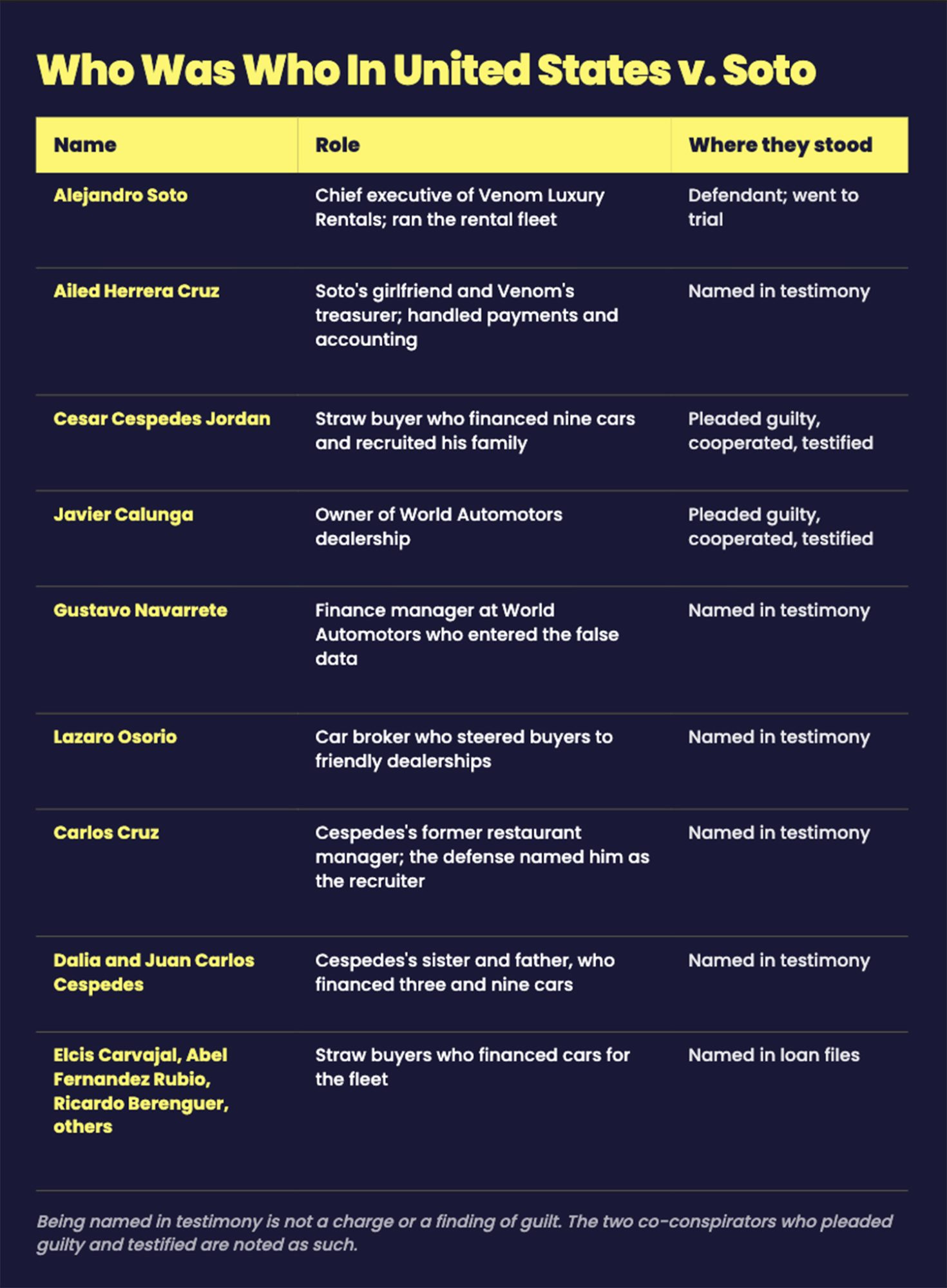
Here are all the people that were named in the case.
Banks, Lenders And Credit Unions Lost Money
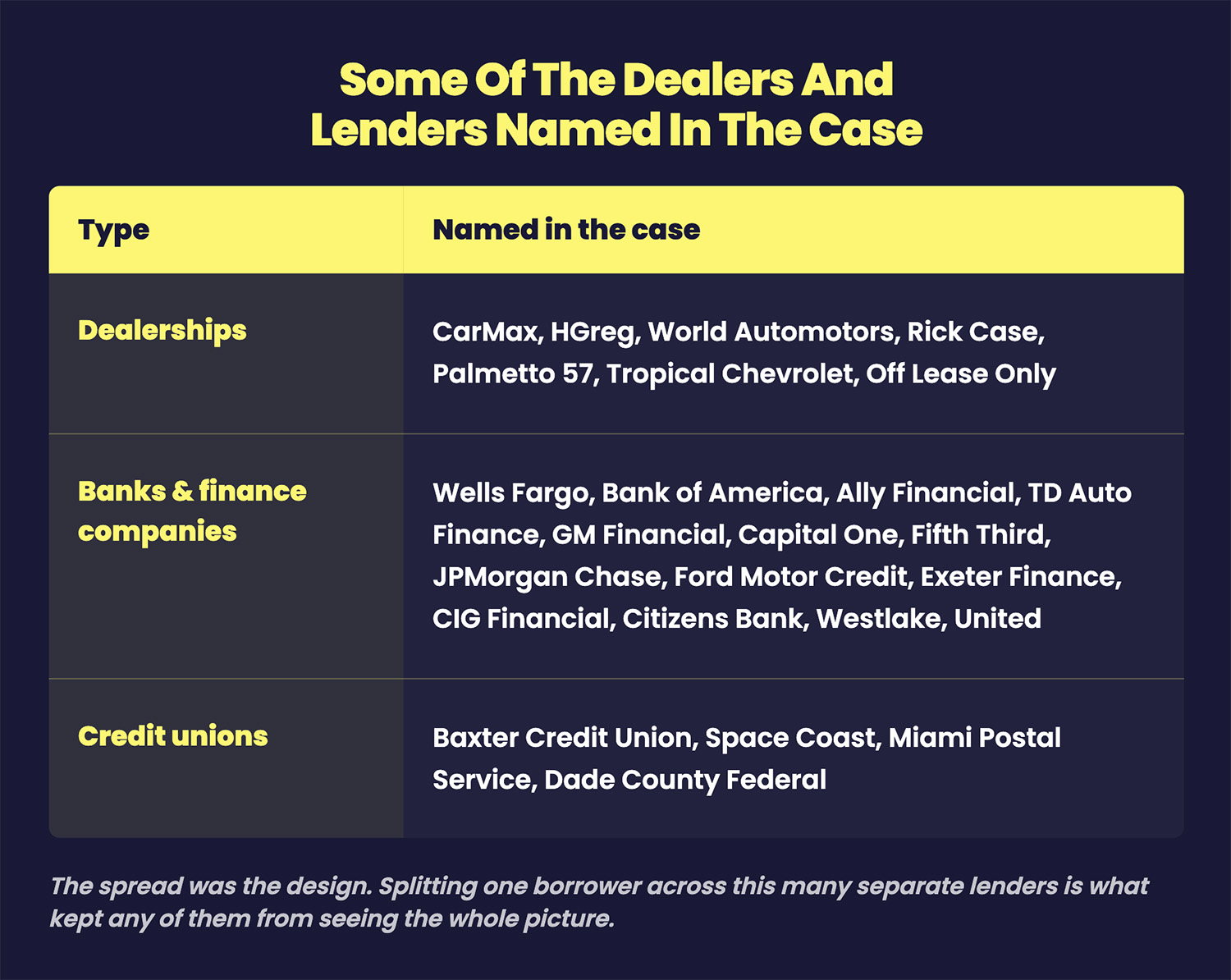
Some of the biggest lenders in the country took losses but even small credit unions were hit as well.
For an inventory of the lenders and cars you can check out the spreadsheet here.
About This Report
Every quote and figure here comes from the public record in United States v. Alejandro Soto, No. 25-CR-20288, in the U.S. District Court for the Southern District of Florida. That includes the charging document and the trial testimony of Cesar Cespedes and Javier Calunga, given on February 24 through 27, 2026.
Quotations are reproduced as they appear in the certified court transcripts, including testimony given through a Spanish interpreter. Where witnesses described people who were not on trial, this report notes that those accounts are testimony, not findings.