By the time the HR representative dialed into what was supposed to be a routine exit interview, the employee on the other end of the call had not actually worked at the company for close to five years.
He was an imposter recruited by his bosses to dial in to the call and read a script praising the company for being supportive.
When the HR rep asked the imposter to join a video call, his bosses bought him a high-quality laptop and used an AI program like DeepFace Live to swap his own face with that of a former employee who had quit long ago.
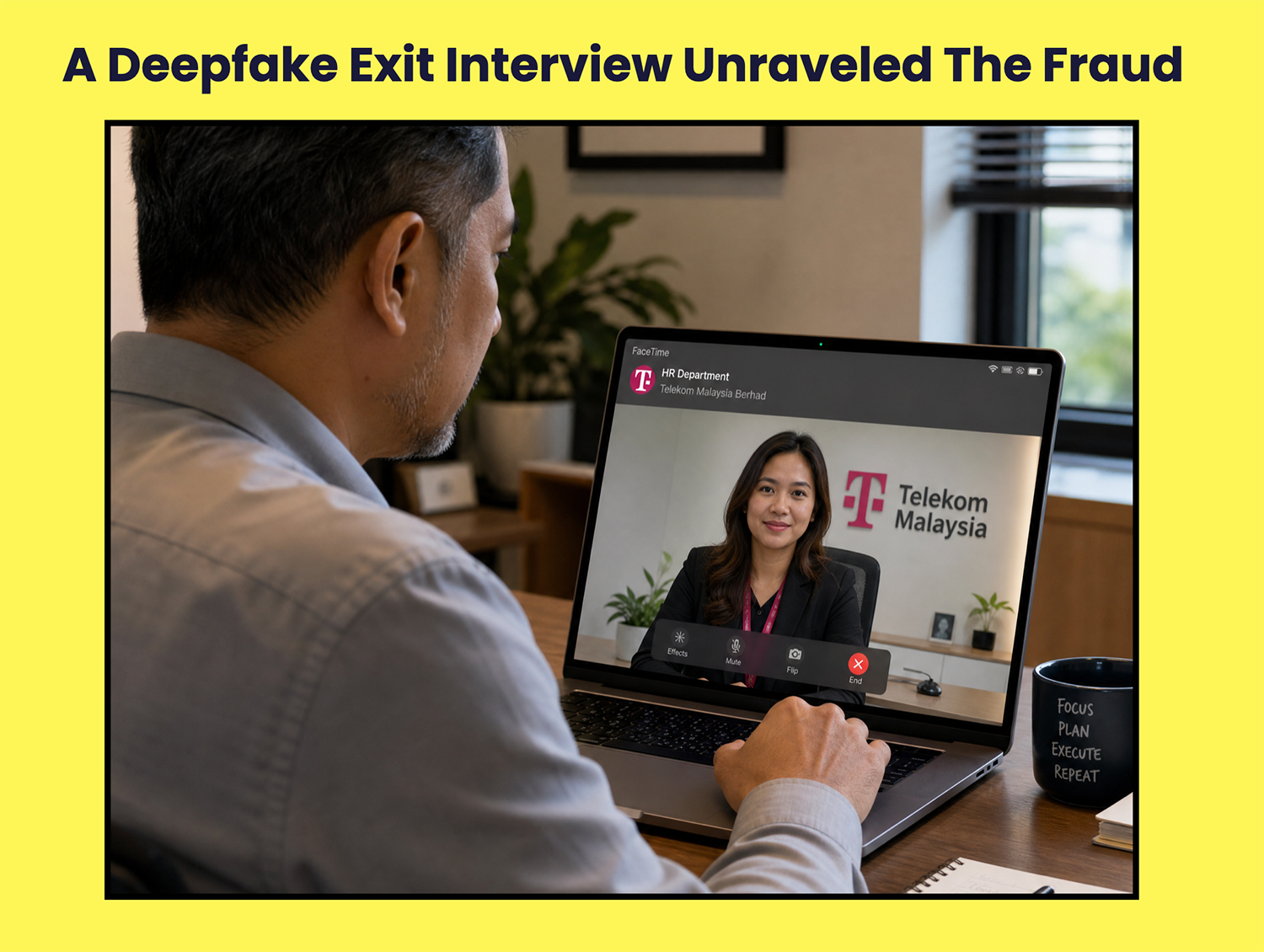
That moment began the unraveling of a massive $20 million insider fraud at the company Telekom Malaysia.
The DOJ charged 3 employees, including Mohd Hafiz Lockman (the regional director), with running four interconnected frauds while employed there.
The Likely DeepFake Tool – DeepFace Live
The indictment is further proof that almost all fraud and scams now use some form of AI. Federal prosecutors did not identify the software the defendants used to create the deepfake. The indictment refers to it only as “an artificial intelligence program.”
But the details of the indictment fit only a handful of tools, with DeepFace Live being the most popular.
It matches what the indictment describes. Mr. Lockman and Mr. Yusof “provided Employee-3 with a photo of the face he was to use,” and Mr. Yusof bought a “high-quality laptop” for the impostor, the kind of consumer hardware Deep-Live-Cam needs to run smoothly.

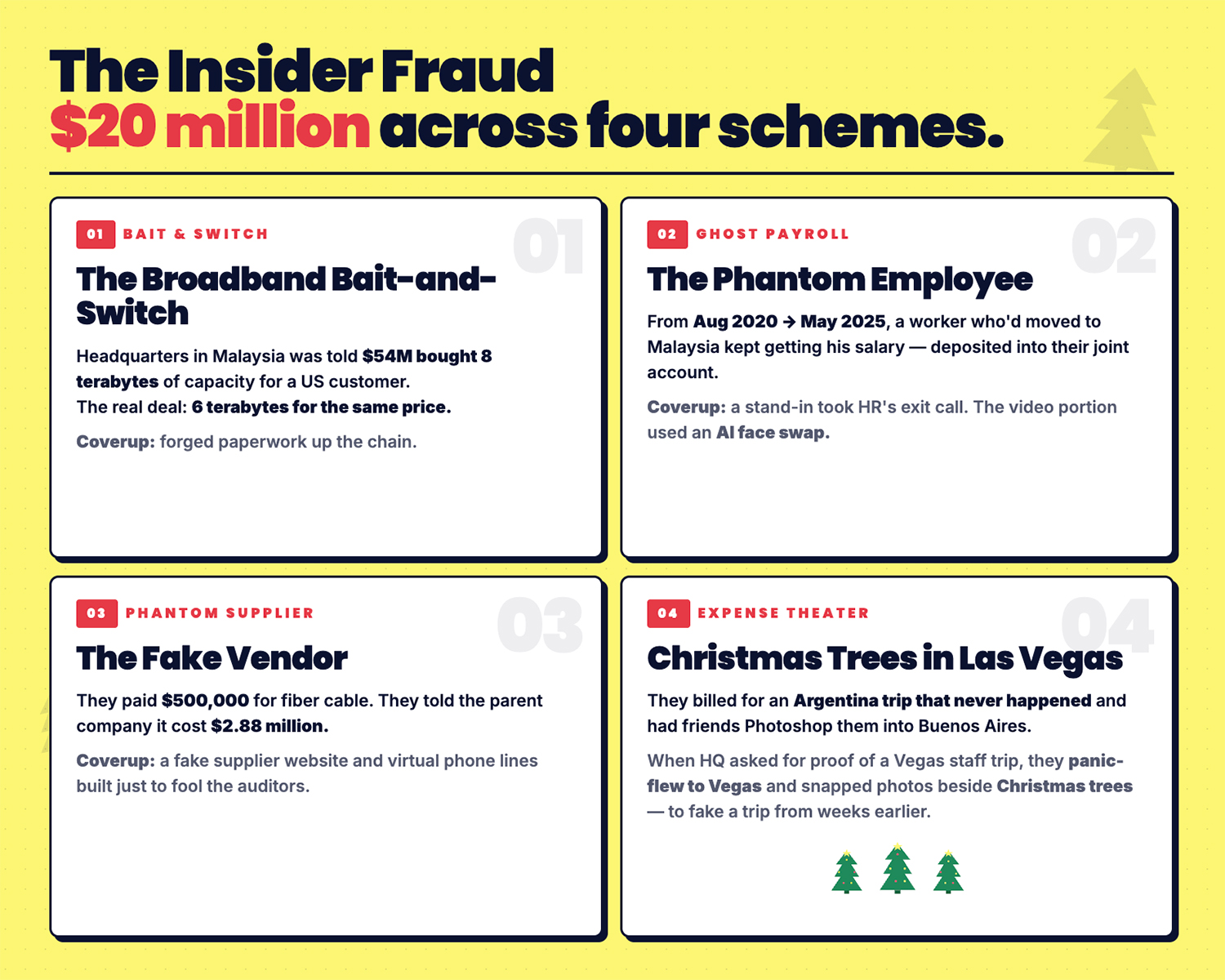
The Insider Fraud – $20 Million Across Four Different Fraud Schemes.
The employees apparently ran not one fraud, but four different interconnected frauds. The schemes show how hard they had to work to conceal their fraud.
#1 – The BroadBand Bait And Switch Fraud
The biggest fraud was a broadband bait-and-switch. The employees told headquarters in Malaysia that $54 million bought eight terabytes of capacity for a US customer. The real deal was six terabytes for the same price.
They forged paperwork to cover up the fraud.
#2 – The Phantom Employee Fraud
The second fraud was that they create a ghost employee. From August 2020 through May 2025, the employees kept depositing a worker’s salary who had moved to Malaysia into their joint account.
When HR finally asked for an exit interview in 2026, they had a stand-in impersonate him by phone, then used an AI face swap on the video call. They also paid fake interns, including one of their own relatives.
#3 – The Phantom Suppliers
The third scheme involved creating a fake vendor. They paid $500,000 for fiber cable but told the parent company it cost $2.88 million.
To fool auditors, they built a fake supplier website and set up virtual phone lines.
#4 – Christmas Trees In Las Vegas
The fourth scheme was fake expense reports. The employees billed the company for an Argentina business trip that never happened, then had friends Photoshop pictures of them in Buenos Aires.
They also billed for a staff trip to Las Vegas. When headquarters asked for proof, they flew to Vegas in a panic and snapped photos next to Christmas trees to make it look like the trip had happened weeks earlier.